
Commutation and Anticommutation Relations in Quantum Mechanics: How They Influence Quantum Operators
Learn how commutation and anticommutation relations shape the behavior of bosons and fermions in quantum mechanics and field theory.

In quantum mechanics, operators are mathematical entities that represent physical quantities such as position, momentum, energy, and others. These operators are essential tools for understanding the behaviour of quantum systems. However, in quantum field theory (QFT), operators often do not commute with one another, meaning the order in which they act on a quantum state matters significantly. This non-commutativity is captured mathematically by the commutation relations and anticommutation relations, which govern how the operators interact when applied together.
In this article, we’ll take an in-depth look at commutation relations and anticommutation relations, especially in the context of bosons and fermions. Understanding these relations is crucial for grasping key quantum concepts and the behaviour of quantum fields. We will explore how creation and annihilation operators behave for both types of particles and why these relations are fundamental to quantum field theory.
What Are Commutation and Anticommutation Relations?
In quantum mechanics, operators often do not commute, meaning that their order of application affects the outcome of the operation. The commutator is a mathematical expression that captures this non-commutative nature. The commutator of two operators A and B is defined as:
If the commutator of two operators is zero, then the operators commute, meaning their order does not affect the result. On the other hand, if the commutator is non-zero, the operators do not commute, and their order of application changes the outcome.
Commutation Relations for Bosons
Bosons are particles that obey Bose-Einstein statistics and are not subject to the Pauli Exclusion Principle, which means that multiple bosons can occupy the same quantum state. This property is crucial for phenomena such as Bose-Einstein condensation and superfluidity. Bosons include particles like photons, gluons, and the Higgs boson.
In quantum field theory, the creation (ψ^†) and annihilation (ψ^) operators for bosonic fields satisfy the following commutation relations:
Here, the delta function δ3(r−r′) ensures that the creation and annihilation operators interact only at the same position in space, i.e., when r=r′. This reflects the fact that bosons can exist in the same quantum state at the same location.
Additionally, the commutation relations for the creation and annihilation operators themselves are:
These relations show that:
The annihilation operator ψ^(r) commutes with itself, meaning the order of two annihilation operators does not matter.
The creation operator ψ^†(r) commutes with itself as well, meaning the order of two creation operators also does not affect the result.
These relations demonstrate that bosons are not restricted by the Pauli Exclusion Principle and can occupy the same quantum state in large numbers.
Real-World Example: Photons and Quantum Electrodynamics (QED)
In quantum electrodynamics (QED), photons are bosons that mediate electromagnetic interactions. The commutation relations for the creation and annihilation operators ensure that multiple photons can occupy the same electromagnetic mode, giving rise to phenomena such as coherent light, interference, and laser action. The photon field is described using creation and annihilation operators that follow these commutation relations, which are essential for understanding light-matter interactions at the quantum level.
Anticommutation Relations for Fermions
Fermions are particles that obey Fermi-Dirac statistics and are subject to the Pauli Exclusion Principle. This principle asserts that no two fermions can occupy the same quantum state simultaneously. This is a key difference between fermions and bosons and leads to the characteristic behaviour of matter at the microscopic level. Electrons, protons, and neutrons are all examples of fermions.
For fermions, the creation and annihilation operators satisfy anticommutation relations. The anticommutator is defined as:
For fermions, the creation (ψ^†) and annihilation (ψ^) operators satisfy the following anticommutation relations:
This relation indicates that the creation and annihilation operators anticommute, meaning swapping their order changes the sign of the result. This behavior reflects the Pauli Exclusion Principle: no two fermions can occupy the same quantum state at the same time.
Other important anticommutation relations for fermions include:
These relations imply:
The annihilation operators do not interact with each other (i.e., two annihilation operators at the same location cannot act simultaneously).
The creation operators also do not interact with each other (i.e., two creation operators acting at the same location do not lead to any new state).
These anticommutation relations enforce the Pauli Exclusion Principle for fermions, ensuring that no two fermions can exist in the same quantum state at the same time.
Real-World Example: Electrons in Atoms
In atoms, electrons are fermions, and the anticommutation relations enforce the Pauli Exclusion Principle, which explains the discrete energy levels in atoms. This principle ensures that no two electrons in an atom can occupy the same set of quantum numbers, resulting in electron configurations that follow the Aufbau principle. This is why atoms have well-defined structures, and it forms the basis for the periodic table of elements.
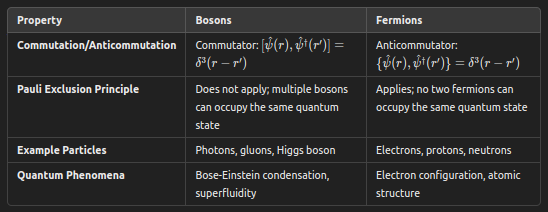
Key Differences Between Bosons and Fermions
Why Are These Relations Important?
Understanding the commutation and anticommutation relations is crucial in quantum mechanics because they dictate how particles interact and behave in quantum systems. For bosons, these relations lead to behaviors like Bose-Einstein condensation, where particles "coalesce" into the same quantum state. For fermions, the Pauli Exclusion Principle shapes the structure of matter, ensuring that particles like electrons cannot occupy the same state simultaneously.
These relations also provide insight into the quantum field theory and are the foundation for more complex theories, such as quantum electrodynamics (QED) and quantum chromodynamics (QCD), which describe the electromagnetic and strong nuclear forces, respectively.
Conclusion
The commutation and anticommutation relations are not just abstract mathematical concepts but fundamental principles that govern the behavior of quantum particles. These relations help us understand the distinct behaviors of bosons and fermions, from the Bose-Einstein condensation of bosons to the discrete energy levels of electrons in atoms. Whether you’re studying quantum field theory, quantum electrodynamics, or even atomic physics, these relations are crucial for understanding the nature of matter and the interactions that govern the quantum world.